

-
1 structural study
-
2 structural study
-
3 structural study
1) Металлургия: исследование структуры2) Золотодобыча: структурный анализ -
4 structural study
Dictionary of Engineering, architecture and construction > structural study
-
5 in conjunction with the structural study
English-Russian dictionary of geology > in conjunction with the structural study
-
6 Depositional-Structural Study
Универсальный англо-русский словарь > Depositional-Structural Study
-
7 in conjunction with the structural study
Золотодобыча: в соответствии со структурным исследованиемУниверсальный англо-русский словарь > in conjunction with the structural study
-
8 structural steel design
English-Russian big polytechnic dictionary > structural steel design
-
9 Bibliography
■ Aitchison, J. (1987). Noam Chomsky: Consensus and controversy. New York: Falmer Press.■ Anderson, J. R. (1980). Cognitive psychology and its implications. San Francisco: W. H. Freeman.■ Anderson, J. R. (1983). The architecture of cognition. Cambridge, MA: Harvard University Press.■ Anderson, J. R. (1995). Cognitive psychology and its implications (4th ed.). New York: W. H. Freeman.■ Archilochus (1971). In M. L. West (Ed.), Iambi et elegi graeci (Vol. 1). Oxford: Oxford University Press.■ Armstrong, D. M. (1990). The causal theory of the mind. In W. G. Lycan (Ed.), Mind and cognition: A reader (pp. 37-47). Cambridge, MA: Basil Blackwell. (Originally published in 1981 in The nature of mind and other essays, Ithaca, NY: University Press).■ Atkins, P. W. (1992). Creation revisited. Oxford: W. H. Freeman & Company.■ Austin, J. L. (1962). How to do things with words. Cambridge, MA: Harvard University Press.■ Bacon, F. (1878). Of the proficience and advancement of learning divine and human. In The works of Francis Bacon (Vol. 1). Cambridge, MA: Hurd & Houghton.■ Bacon, R. (1928). Opus majus (Vol. 2). R. B. Burke (Trans.). Philadelphia, PA: University of Pennsylvania Press.■ Bar-Hillel, Y. (1960). The present status of automatic translation of languages. In F. L. Alt (Ed.), Advances in computers (Vol. 1). New York: Academic Press.■ Barr, A., & E. A. Feigenbaum (Eds.) (1981). The handbook of artificial intelligence (Vol. 1). Reading, MA: Addison-Wesley.■ Barr, A., & E. A. Feigenbaum (Eds.) (1982). The handbook of artificial intelligence (Vol. 2). Los Altos, CA: William Kaufman.■ Barron, F. X. (1963). The needs for order and for disorder as motives in creative activity. In C. W. Taylor & F. X. Barron (Eds.), Scientific creativity: Its rec ognition and development (pp. 153-160). New York: Wiley.■ Bartlett, F. C. (1932). Remembering: A study in experimental and social psychology. Cambridge: Cambridge University Press.■ Bartley, S. H. (1969). Principles of perception. London: Harper & Row.■ Barzun, J. (1959). The house of intellect. New York: Harper & Row.■ Beach, F. A., D. O. Hebb, C. T. Morgan & H. W. Nissen (Eds.) (1960). The neu ropsychology of Lashley. New York: McGraw-Hill.■ Berkeley, G. (1996). Principles of human knowledge: Three Dialogues. Oxford: Oxford University Press. (Originally published in 1710.)■ Berlin, I. (1953). The hedgehog and the fox: An essay on Tolstoy's view of history. NY: Simon & Schuster.■ Bierwisch, J. (1970). Semantics. In J. Lyons (Ed.), New horizons in linguistics. Baltimore: Penguin Books.■ Black, H. C. (1951). Black's law dictionary. St. Paul, MN: West Publishing.■ Bloom, A. (1981). The linguistic shaping of thought: A study in the impact of language on thinking in China and the West. Hillsdale, NJ: Erlbaum.■ Bobrow, D. G., & D. A. Norman (1975). Some principles of memory schemata. In D. G. Bobrow & A. Collins (Eds.), Representation and understanding: Stud ies in Cognitive Science (pp. 131-149). New York: Academic Press.■ Boden, M. A. (1977). Artificial intelligence and natural man. New York: Basic Books.■ Boden, M. A. (1981). Minds and mechanisms. Ithaca, NY: Cornell University Press.■ Boden, M. A. (1990a). The creative mind: Myths and mechanisms. London: Cardinal.■ Boden, M. A. (1990b). The philosophy of artificial intelligence. Oxford: Oxford University Press.■ Boden, M. A. (1994). Precis of The creative mind: Myths and mechanisms. Behavioral and brain sciences 17, 519-570.■ Boden, M. (1996). Creativity. In M. Boden (Ed.), Artificial Intelligence (2nd ed.). San Diego: Academic Press.■ Bolter, J. D. (1984). Turing's man: Western culture in the computer age. Chapel Hill, NC: University of North Carolina Press.■ Bolton, N. (1972). The psychology of thinking. London: Methuen.■ Bourne, L. E. (1973). Some forms of cognition: A critical analysis of several papers. In R. Solso (Ed.), Contemporary issues in cognitive psychology (pp. 313324). Loyola Symposium on Cognitive Psychology (Chicago 1972). Washington, DC: Winston.■ Bransford, J. D., N. S. McCarrell, J. J. Franks & K. E. Nitsch (1977). Toward unexplaining memory. In R. Shaw & J. D. Bransford (Eds.), Perceiving, acting, and knowing (pp. 431-466). Hillsdale, NJ: Lawrence Erlbaum Associates.■ Breger, L. (1981). Freud's unfinished journey. London: Routledge & Kegan Paul.■ Brehmer, B. (1986). In one word: Not from experience. In H. R. Arkes & K. Hammond (Eds.), Judgment and decision making: An interdisciplinary reader (pp. 705-719). Cambridge: Cambridge University Press.■ Bresnan, J. (1978). A realistic transformational grammar. In M. Halle, J. Bresnan & G. A. Miller (Eds.), Linguistic theory and psychological reality (pp. 1-59). Cambridge, MA: MIT Press.■ Brislin, R. W., W. J. Lonner & R. M. Thorndike (Eds.) (1973). Cross- cultural research methods. New York: Wiley.■ Bronowski, J. (1977). A sense of the future: Essays in natural philosophy. P. E. Ariotti with R. Bronowski (Eds.). Cambridge, MA: MIT Press.■ Bronowski, J. (1978). The origins of knowledge and imagination. New Haven, CT: Yale University Press.■ Brown, R. O. (1973). A first language: The early stages. Cambridge, MA: Harvard University Press.■ Brown, T. (1970). Lectures on the philosophy of the human mind. In R. Brown (Ed.), Between Hume and Mill: An anthology of British philosophy- 1749- 1843 (pp. 330-387). New York: Random House/Modern Library.■ Bruner, J. S., J. Goodnow & G. Austin (1956). A study of thinking. New York: Wiley.■ Calvin, W. H. (1990). The cerebral symphony: Seashore reflections on the structure of consciousness. New York: Bantam.■ Campbell, J. (1982). Grammatical man: Information, entropy, language, and life. New York: Simon & Schuster.■ Campbell, J. (1989). The improbable machine. New York: Simon & Schuster.■ Carlyle, T. (1966). On heroes, hero- worship and the heroic in history. Lincoln: University of Nebraska Press. (Originally published in 1841.)■ Carnap, R. (1959). The elimination of metaphysics through logical analysis of language [Ueberwindung der Metaphysik durch logische Analyse der Sprache]. In A. J. Ayer (Ed.), Logical positivism (pp. 60-81) A. Pap (Trans). New York: Free Press. (Originally published in 1932.)■ Cassirer, E. (1946). Language and myth. New York: Harper and Brothers. Reprinted. New York: Dover Publications, 1953.■ Cattell, R. B., & H. J. Butcher (1970). Creativity and personality. In P. E. Vernon (Ed.), Creativity. Harmondsworth, England: Penguin Books.■ Caudill, M., & C. Butler (1990). Naturally intelligent systems. Cambridge, MA: MIT Press/Bradford Books.■ Chandrasekaran, B. (1990). What kind of information processing is intelligence? A perspective on AI paradigms and a proposal. In D. Partridge & R. Wilks (Eds.), The foundations of artificial intelligence: A sourcebook (pp. 14-46). Cambridge: Cambridge University Press.■ Charniak, E., & McDermott, D. (1985). Introduction to artificial intelligence. Reading, MA: Addison-Wesley.■ Chase, W. G., & H. A. Simon (1988). The mind's eye in chess. In A. Collins & E. E. Smith (Eds.), Readings in cognitive science: A perspective from psychology and artificial intelligence (pp. 461-493). San Mateo, CA: Kaufmann.■ Cheney, D. L., & R. M. Seyfarth (1990). How monkeys see the world: Inside the mind of another species. Chicago: University of Chicago Press.■ Chi, M.T.H., R. Glaser & E. Rees (1982). Expertise in problem solving. In R. J. Sternberg (Ed.), Advances in the psychology of human intelligence (pp. 7-73). Hillsdale, NJ: Lawrence Erlbaum Associates.■ Chomsky, N. (1957). Syntactic structures. The Hague: Mouton. Janua Linguarum.■ Chomsky, N. (1964). A transformational approach to syntax. In J. A. Fodor & J. J. Katz (Eds.), The structure of language: Readings in the philosophy of lan guage (pp. 211-245). Englewood Cliffs, NJ: Prentice-Hall.■ Chomsky, N. (1965). Aspects of the theory of syntax. Cambridge, MA: MIT Press.■ Chomsky, N. (1972). Language and mind (enlarged ed.). New York: Harcourt Brace Jovanovich.■ Chomsky, N. (1979). Language and responsibility. New York: Pantheon.■ Chomsky, N. (1986). Knowledge of language: Its nature, origin and use. New York: Praeger Special Studies.■ Churchland, P. (1979). Scientific realism and the plasticity of mind. New York: Cambridge University Press.■ Churchland, P. M. (1989). A neurocomputational perspective: The nature of mind and the structure of science. Cambridge, MA: MIT Press.■ Churchland, P. S. (1986). Neurophilosophy. Cambridge, MA: MIT Press/Bradford Books.■ Clark, A. (1996). Philosophical Foundations. In M. A. Boden (Ed.), Artificial in telligence (2nd ed.). San Diego: Academic Press.■ Clark, H. H., & T. B. Carlson (1981). Context for comprehension. In J. Long & A. Baddeley (Eds.), Attention and performance (Vol. 9, pp. 313-330). Hillsdale, NJ: Lawrence Erlbaum Associates.■ Clarke, A. C. (1984). Profiles of the future: An inquiry into the limits of the possible. New York: Holt, Rinehart & Winston.■ Claxton, G. (1980). Cognitive psychology: A suitable case for what sort of treatment? In G. Claxton (Ed.), Cognitive psychology: New directions (pp. 1-25). London: Routledge & Kegan Paul.■ Code, M. (1985). Order and organism. Albany, NY: State University of New York Press.■ Collingwood, R. G. (1972). The idea of history. New York: Oxford University Press.■ Coopersmith, S. (1967). The antecedents of self- esteem. San Francisco: W. H. Freeman.■ Copland, A. (1952). Music and imagination. London: Oxford University Press.■ Coren, S. (1994). The intelligence of dogs. New York: Bantam Books.■ Cottingham, J. (Ed.) (1996). Western philosophy: An anthology. Oxford: Blackwell Publishers.■ Cox, C. (1926). The early mental traits of three hundred geniuses. Stanford, CA: Stanford University Press.■ Craik, K.J.W. (1943). The nature of explanation. Cambridge: Cambridge University Press.■ Cronbach, L. J. (1990). Essentials of psychological testing (5th ed.). New York: HarperCollins.■ Cronbach, L. J., & R. E. Snow (1977). Aptitudes and instructional methods. New York: Irvington. Paperback edition, 1981.■ Csikszentmihalyi, M. (1993). The evolving self. New York: Harper Perennial.■ Culler, J. (1976). Ferdinand de Saussure. New York: Penguin Books.■ Curtius, E. R. (1973). European literature and the Latin Middle Ages. W. R. Trask (Trans.). Princeton, NJ: Princeton University Press.■ D'Alembert, J.L.R. (1963). Preliminary discourse to the encyclopedia of Diderot. R. N. Schwab (Trans.). Indianapolis: Bobbs-Merrill.■ Dampier, W. C. (1966). A history of modern science. Cambridge: Cambridge University Press.■ Darwin, C. (1911). The life and letters of Charles Darwin (Vol. 1). Francis Darwin (Ed.). New York: Appleton.■ Davidson, D. (1970) Mental events. In L. Foster & J. W. Swanson (Eds.), Experience and theory (pp. 79-101). Amherst: University of Massachussetts Press.■ Davies, P. (1995). About time: Einstein's unfinished revolution. New York: Simon & Schuster/Touchstone.■ Davis, R., & J. J. King (1977). An overview of production systems. In E. Elcock & D. Michie (Eds.), Machine intelligence 8. Chichester, England: Ellis Horwood.■ Davis, R., & D. B. Lenat (1982). Knowledge- based systems in artificial intelligence. New York: McGraw-Hill.■ Dawkins, R. (1982). The extended phenotype: The gene as the unit of selection. Oxford: W. H. Freeman.■ deKleer, J., & J. S. Brown (1983). Assumptions and ambiguities in mechanistic mental models (1983). In D. Gentner & A. L. Stevens (Eds.), Mental modes (pp. 155-190). Hillsdale, NJ: Lawrence Erlbaum Associates.■ Dennett, D. C. (1978a). Brainstorms: Philosophical essays on mind and psychology. Montgomery, VT: Bradford Books.■ Dennett, D. C. (1978b). Toward a cognitive theory of consciousness. In D. C. Dennett, Brainstorms: Philosophical Essays on Mind and Psychology. Montgomery, VT: Bradford Books.■ Dennett, D. C. (1995). Darwin's dangerous idea: Evolution and the meanings of life. New York: Simon & Schuster/Touchstone.■ Descartes, R. (1897-1910). Traite de l'homme. In Oeuvres de Descartes (Vol. 11, pp. 119-215). Paris: Charles Adam & Paul Tannery. (Originally published in 1634.)■ Descartes, R. (1950). Discourse on method. L. J. Lafleur (Trans.). New York: Liberal Arts Press. (Originally published in 1637.)■ Descartes, R. (1951). Meditation on first philosophy. L. J. Lafleur (Trans.). New York: Liberal Arts Press. (Originally published in 1641.)■ Descartes, R. (1955). The philosophical works of Descartes. E. S. Haldane and G.R.T. Ross (Trans.). New York: Dover. (Originally published in 1911 by Cambridge University Press.)■ Descartes, R. (1967). Discourse on method (Pt. V). In E. S. Haldane and G.R.T. Ross (Eds.), The philosophical works of Descartes (Vol. 1, pp. 106-118). Cambridge: Cambridge University Press. (Originally published in 1637.)■ Descartes, R. (1970a). Discourse on method. In E. S. Haldane & G.R.T. Ross (Eds.), The philosophical works of Descartes (Vol. 1, pp. 181-200). Cambridge: Cambridge University Press. (Originally published in 1637.)■ Descartes, R. (1970b). Principles of philosophy. In E. S. Haldane & G.R.T. Ross (Eds.), The philosophical works of Descartes (Vol. 1, pp. 178-291). Cambridge: Cambridge University Press. (Originally published in 1644.)■ Descartes, R. (1984). Meditations on first philosophy. In J. Cottingham, R. Stoothoff & D. Murduch (Trans.), The philosophical works of Descartes (Vol. 2). Cambridge: Cambridge University Press. (Originally published in 1641.)■ Descartes, R. (1986). Meditations on first philosophy. J. Cottingham (Trans.). Cambridge: Cambridge University Press. (Originally published in 1641 as Med itationes de prima philosophia.)■ deWulf, M. (1956). An introduction to scholastic philosophy. Mineola, NY: Dover Books.■ Dixon, N. F. (1981). Preconscious processing. London: Wiley.■ Doyle, A. C. (1986). The Boscombe Valley mystery. In Sherlock Holmes: The com plete novels and stories (Vol. 1). New York: Bantam.■ Dreyfus, H., & S. Dreyfus (1986). Mind over machine. New York: Free Press.■ Dreyfus, H. L. (1972). What computers can't do: The limits of artificial intelligence (revised ed.). New York: Harper & Row.■ Dreyfus, H. L., & S. E. Dreyfus (1986). Mind over machine: The power of human intuition and expertise in the era of the computer. New York: Free Press.■ Edelman, G. M. (1992). Bright air, brilliant fire: On the matter of the mind. New York: Basic Books.■ Ehrenzweig, A. (1967). The hidden order of art. London: Weidenfeld & Nicolson.■ Einstein, A., & L. Infeld (1938). The evolution of physics. New York: Simon & Schuster.■ Eisenstein, S. (1947). Film sense. New York: Harcourt, Brace & World.■ Everdell, W. R. (1997). The first moderns. Chicago: University of Chicago Press.■ Eysenck, M. W. (1977). Human memory: Theory, research and individual difference. Oxford: Pergamon.■ Eysenck, M. W. (1982). Attention and arousal: Cognition and performance. Berlin: Springer.■ Eysenck, M. W. (1984). A handbook of cognitive psychology. Hillsdale, NJ: Lawrence Erlbaum Associates.■ Fancher, R. E. (1979). Pioneers of psychology. New York: W. W. Norton.■ Farrell, B. A. (1981). The standing of psychoanalysis. New York: Oxford University Press.■ Feldman, D. H. (1980). Beyond universals in cognitive development. Norwood, NJ: Ablex.■ Fetzer, J. H. (1996). Philosophy and cognitive science (2nd ed.). New York: Paragon House.■ Finke, R. A. (1990). Creative imagery: Discoveries and inventions in visualization. Hillsdale, NJ: Lawrence Erlbaum Associates.■ Flanagan, O. (1991). The science of the mind. Cambridge MA: MIT Press/Bradford Books.■ Fodor, J. (1983). The modularity of mind. Cambridge, MA: MIT Press/Bradford Books.■ Frege, G. (1972). Conceptual notation. T. W. Bynum (Trans.). Oxford: Clarendon Press. (Originally published in 1879.)■ Frege, G. (1979). Logic. In H. Hermes, F. Kambartel & F. Kaulbach (Eds.), Gottlob Frege: Posthumous writings. Chicago: University of Chicago Press. (Originally published in 1879-1891.)■ Freud, S. (1959). Creative writers and day-dreaming. In J. Strachey (Ed.), The standard edition of the complete psychological works of Sigmund Freud (Vol. 9, pp. 143-153). London: Hogarth Press.■ Freud, S. (1966). Project for a scientific psychology. In J. Strachey (Ed.), The stan dard edition of the complete psychological works of Sigmund Freud (Vol. 1, pp. 295-398). London: Hogarth Press. (Originally published in 1950 as Aus den AnfaЁngen der Psychoanalyse, in London by Imago Publishing.)■ Freud, S. (1976). Lecture 18-Fixation to traumas-the unconscious. In J. Strachey (Ed.), The standard edition of the complete psychological works of Sigmund Freud (Vol. 16, p. 285). London: Hogarth Press.■ Galileo, G. (1990). Il saggiatore [The assayer]. In S. Drake (Ed.), Discoveries and opinions of Galileo. New York: Anchor Books. (Originally published in 1623.)■ Gassendi, P. (1970). Letter to Descartes. In "Objections and replies." In E. S. Haldane & G.R.T. Ross (Eds.), The philosophical works of Descartes (Vol. 2, pp. 179-240). Cambridge: Cambridge University Press. (Originally published in 1641.)■ Gazzaniga, M. S. (1988). Mind matters: How mind and brain interact to create our conscious lives. Boston: Houghton Mifflin in association with MIT Press/Bradford Books.■ Genesereth, M. R., & N. J. Nilsson (1987). Logical foundations of artificial intelligence. Palo Alto, CA: Morgan Kaufmann.■ Ghiselin, B. (1952). The creative process. New York: Mentor.■ Ghiselin, B. (1985). The creative process. Berkeley, CA: University of California Press. (Originally published in 1952.)■ Gilhooly, K. J. (1996). Thinking: Directed, undirected and creative (3rd ed.). London: Academic Press.■ Glass, A. L., K. J. Holyoak & J. L. Santa (1979). Cognition. Reading, MA: AddisonWesley.■ Goody, J. (1977). The domestication of the savage mind. Cambridge: Cambridge University Press.■ Gruber, H. E. (1980). Darwin on man: A psychological study of scientific creativity (2nd ed.). Chicago: University of Chicago Press.■ Gruber, H. E., & S. Davis (1988). Inching our way up Mount Olympus: The evolving systems approach to creative thinking. In R. J. Sternberg (Ed.), The nature of creativity: Contemporary psychological perspectives. Cambridge: Cambridge University Press.■ Guthrie, E. R. (1972). The psychology of learning. New York: Harper. (Originally published in 1935.)■ Habermas, J. (1972). Knowledge and human interests. Boston: Beacon Press.■ Hadamard, J. (1945). The psychology of invention in the mathematical field. Princeton, NJ: Princeton University Press.■ Hand, D. J. (1985). Artificial intelligence and psychiatry. Cambridge: Cambridge University Press.■ Harris, M. (1981). The language myth. London: Duckworth.■ Haugeland, J. (Ed.) (1981). Mind design: Philosophy, psychology, artificial intelligence. Cambridge, MA: MIT Press/Bradford Books.■ Haugeland, J. (1981a). The nature and plausibility of cognitivism. In J. Haugeland (Ed.), Mind design: Philosophy, psychology, artificial intelligence (pp. 243-281). Cambridge, MA: MIT Press.■ Haugeland, J. (1981b). Semantic engines: An introduction to mind design. In J. Haugeland (Ed.), Mind design: Philosophy, psychology, artificial intelligence (pp. 1-34). Cambridge, MA: MIT Press/Bradford Books.■ Haugeland, J. (1985). Artificial intelligence: The very idea. Cambridge, MA: MIT Press.■ Hawkes, T. (1977). Structuralism and semiotics. Berkeley: University of California Press.■ Hebb, D. O. (1949). The organisation of behaviour. New York: Wiley.■ Hebb, D. O. (1958). A textbook of psychology. Philadelphia: Saunders.■ Hegel, G.W.F. (1910). The phenomenology of mind. J. B. Baille (Trans.). London: Sonnenschein. (Originally published as Phaenomenologie des Geistes, 1807.)■ Heisenberg, W. (1958). Physics and philosophy. New York: Harper & Row.■ Hempel, C. G. (1966). Philosophy of natural science. Englewood Cliffs, NJ: PrenticeHall.■ Herman, A. (1997). The idea of decline in Western history. New York: Free Press.■ Herrnstein, R. J., & E. G. Boring (Eds.) (1965). A source book in the history of psy chology. Cambridge, MA: Harvard University Press.■ Herzmann, E. (1964). Mozart's creative process. In P. H. Lang (Ed.), The creative world of Mozart (pp. 17-30). London: Oldbourne Press.■ Hilgard, E. R. (1957). Introduction to psychology. London: Methuen.■ Hobbes, T. (1651). Leviathan. London: Crooke.■ Holliday, S. G., & M. J. Chandler (1986). Wisdom: Explorations in adult competence. Basel, Switzerland: Karger.■ Horn, J. L. (1986). In R. J. Sternberg (Ed.), Advances in the psychology of human intelligence (Vol. 3). Hillsdale, NJ: Erlbaum.■ Hull, C. (1943). Principles of behavior. New York: Appleton-Century-Crofts.■ Hume, D. (1955). An inquiry concerning human understanding. New York: Liberal Arts Press. (Originally published in 1748.)■ Hume, D. (1975). An enquiry concerning human understanding. In L. A. SelbyBigge (Ed.), Hume's enquiries (3rd. ed., revised P. H. Nidditch). Oxford: Clarendon. (Spelling and punctuation revised.) (Originally published in 1748.)■ Hume, D. (1978). A treatise of human nature. L. A. Selby-Bigge (Ed.), Hume's enquiries (3rd. ed., revised P. H. Nidditch). Oxford: Clarendon. (With some modifications of spelling and punctuation.) (Originally published in 1690.)■ Hunt, E. (1973). The memory we must have. In R. C. Schank & K. M. Colby (Eds.), Computer models of thought and language. (pp. 343-371) San Francisco: W. H. Freeman.■ Husserl, E. (1960). Cartesian meditations. The Hague: Martinus Nijhoff.■ Inhelder, B., & J. Piaget (1958). The growth of logical thinking from childhood to adolescence. New York: Basic Books. (Originally published in 1955 as De la logique de l'enfant a` la logique de l'adolescent. [Paris: Presses Universitaire de France])■ James, W. (1890a). The principles of psychology (Vol. 1). New York: Dover Books.■ James, W. (1890b). The principles of psychology. New York: Henry Holt.■ Jevons, W. S. (1900). The principles of science (2nd ed.). London: Macmillan.■ Johnson, G. (1986). Machinery of the mind: Inside the new science of artificial intelli gence. New York: Random House.■ Johnson-Laird, P. N. (1983). Mental models: Toward a cognitive science of language, inference, and consciousness. Cambridge, MA: Harvard University Press.■ Johnson-Laird, P. N. (1988). The computer and the mind: An introduction to cognitive science. Cambridge, MA: Harvard University Press.■ Jones, E. (1961). The life and work of Sigmund Freud. L. Trilling & S. Marcus (Eds.). London: Hogarth.■ Jones, R. V. (1985). Complementarity as a way of life. In A. P. French & P. J. Kennedy (Eds.), Niels Bohr: A centenary volume. Cambridge, MA: Harvard University Press.■ Kant, I. (1933). Critique of Pure Reason (2nd ed.). N. K. Smith (Trans.). London: Macmillan. (Originally published in 1781 as Kritik der reinen Vernunft.)■ Kant, I. (1891). Solution of the general problems of the Prolegomena. In E. Belfort (Trans.), Kant's Prolegomena. London: Bell. (With minor modifications.) (Originally published in 1783.)■ Katona, G. (1940). Organizing and memorizing: Studies in the psychology of learning and teaching. New York: Columbia University Press.■ Kaufman, A. S. (1979). Intelligent testing with the WISC-R. New York: Wiley.■ Koestler, A. (1964). The act of creation. New York: Arkana (Penguin).■ Kohlberg, L. (1971). From is to ought. In T. Mischel (Ed.), Cognitive development and epistemology. (pp. 151-235) New York: Academic Press.■ KoЁhler, W. (1925). The mentality of apes. New York: Liveright.■ KoЁhler, W. (1927). The mentality of apes (2nd ed.). Ella Winter (Trans.). London: Routledge & Kegan Paul.■ KoЁhler, W. (1930). Gestalt psychology. London: G. Bell.■ KoЁhler, W. (1947). Gestalt psychology. New York: Liveright.■ KoЁhler, W. (1969). The task of Gestalt psychology. Princeton, NJ: Princeton University Press.■ Kuhn, T. (1970). The structure of scientific revolutions (2nd ed.). Chicago: University of Chicago Press.■ Langer, E. J. (1989). Mindfulness. Reading, MA: Addison-Wesley.■ Langer, S. (1962). Philosophical sketches. Baltimore: Johns Hopkins University Press.■ Langley, P., H. A. Simon, G. L. Bradshaw & J. M. Zytkow (1987). Scientific dis covery: Computational explorations of the creative process. Cambridge, MA: MIT Press.■ Lashley, K. S. (1951). The problem of serial order in behavior. In L. A. Jeffress (Ed.), Cerebral mechanisms in behavior, the Hixon Symposium (pp. 112-146) New York: Wiley.■ LeDoux, J. E., & W. Hirst (1986). Mind and brain: Dialogues in cognitive neuroscience. Cambridge: Cambridge University Press.■ Lehnert, W. (1978). The process of question answering. Hillsdale, NJ: Lawrence Erlbaum Associates.■ Leiber, J. (1991). Invitation to cognitive science. Oxford: Blackwell.■ Lenat, D. B., & G. Harris (1978). Designing a rule system that searches for scientific discoveries. In D. A. Waterman & F. Hayes-Roth (Eds.), Pattern directed inference systems (pp. 25-52) New York: Academic Press.■ Levenson, T. (1995). Measure for measure: A musical history of science. New York: Touchstone. (Originally published in 1994.)■ Leґvi-Strauss, C. (1963). Structural anthropology. C. Jacobson & B. Grundfest Schoepf (Trans.). New York: Basic Books. (Originally published in 1958.)■ Levine, M. W., & J. M. Schefner (1981). Fundamentals of sensation and perception. London: Addison-Wesley.■ Lewis, C. I. (1946). An analysis of knowledge and valuation. LaSalle, IL: Open Court.■ Lighthill, J. (1972). A report on artificial intelligence. Unpublished manuscript, Science Research Council.■ Lipman, M., A. M. Sharp & F. S. Oscanyan (1980). Philosophy in the classroom. Philadelphia: Temple University Press.■ Lippmann, W. (1965). Public opinion. New York: Free Press. (Originally published in 1922.)■ Locke, J. (1956). An essay concerning human understanding. Chicago: Henry Regnery Co. (Originally published in 1690.)■ Locke, J. (1975). An essay concerning human understanding. P. H. Nidditch (Ed.). Oxford: Clarendon. (Originally published in 1690.) (With spelling and punctuation modernized and some minor modifications of phrasing.)■ Lopate, P. (1994). The art of the personal essay. New York: Doubleday/Anchor Books.■ Lorimer, F. (1929). The growth of reason. London: Kegan Paul. Machlup, F., & U. Mansfield (Eds.) (1983). The study of information. New York: Wiley.■ Manguel, A. (1996). A history of reading. New York: Viking.■ Markey, J. F. (1928). The symbolic process. London: Kegan Paul.■ Martin, R. M. (1969). On Ziff's "Natural and formal languages." In S. Hook (Ed.), Language and philosophy: A symposium (pp. 249-263). New York: New York University Press.■ Mazlish, B. (1993). The fourth discontinuity: the co- evolution of humans and machines. New Haven, CT: Yale University Press.■ McCarthy, J., & P. J. Hayes (1969). Some philosophical problems from the standpoint of artificial intelligence. In B. Meltzer & D. Michie (Eds.), Machine intelligence 4. Edinburgh: Edinburgh University Press.■ McClelland, J. L., D. E. Rumelhart & G. E. Hinton (1986). The appeal of parallel distributed processing. In D. E. Rumelhart, J. L. McClelland & the PDP Research Group (Eds.), Parallel distributed processing: Explorations in the mi crostructure of cognition (Vol. 1, pp. 3-40). Cambridge, MA: MIT Press/ Bradford Books.■ McCorduck, P. (1979). Machines who think. San Francisco: W. H. Freeman.■ McLaughlin, T. (1970). Music and communication. London: Faber & Faber.■ Mednick, S. A. (1962). The associative basis of the creative process. Psychological Review 69, 431-436.■ Meehl, P. E., & C. J. Golden (1982). Taxometric methods. In Kendall, P. C., & Butcher, J. N. (Eds.), Handbook of research methods in clinical psychology (pp. 127-182). New York: Wiley.■ Mehler, J., E.C.T. Walker & M. Garrett (Eds.) (1982). Perspectives on mental rep resentation: Experimental and theoretical studies of cognitive processes and ca pacities. Hillsdale, NJ: Lawrence Erlbaum Associates.■ Mill, J. S. (1900). A system of logic, ratiocinative and inductive: Being a connected view of the principles of evidence and the methods of scientific investigation. London: Longmans, Green.■ Miller, G. A. (1979, June). A very personal history. Talk to the Cognitive Science Workshop, Cambridge, MA.■ Miller, J. (1983). States of mind. New York: Pantheon Books.■ Minsky, M. (1975). A framework for representing knowledge. In P. H. Winston (Ed.), The psychology of computer vision (pp. 211-277). New York: McGrawHill.■ Minsky, M., & S. Papert (1973). Artificial intelligence. Condon Lectures, Oregon State System of Higher Education, Eugene, Oregon.■ Minsky, M. L. (1986). The society of mind. New York: Simon & Schuster.■ Mischel, T. (1976). Psychological explanations and their vicissitudes. In J. K. Cole & W. J. Arnold (Eds.), Nebraska Symposium on motivation (Vol. 23). Lincoln, NB: University of Nebraska Press.■ Morford, M.P.O., & R. J. Lenardon (1995). Classical mythology (5th ed.). New York: Longman.■ Murdoch, I. (1954). Under the net. New York: Penguin.■ Nagel, E. (1959). Methodological issues in psychoanalytic theory. In S. Hook (Ed.), Psychoanalysis, scientific method, and philosophy: A symposium. New York: New York University Press.■ Nagel, T. (1979). Mortal questions. London: Cambridge University Press.■ Nagel, T. (1986). The view from nowhere. Oxford: Oxford University Press.■ Neisser, U. (1967). Cognitive psychology. New York: Appleton-Century-Crofts.■ Neisser, U. (1972). Changing conceptions of imagery. In P. W. Sheehan (Ed.), The function and nature of imagery (pp. 233-251). London: Academic Press.■ Neisser, U. (1976). Cognition and reality. San Francisco: W. H. Freeman.■ Neisser, U. (1978). Memory: What are the important questions? In M. M. Gruneberg, P. E. Morris & R. N. Sykes (Eds.), Practical aspects of memory (pp. 3-24). London: Academic Press.■ Neisser, U. (1979). The concept of intelligence. In R. J. Sternberg & D. K. Detterman (Eds.), Human intelligence: Perspectives on its theory and measurement (pp. 179-190). Norwood, NJ: Ablex.■ Nersessian, N. (1992). How do scientists think? Capturing the dynamics of conceptual change in science. In R. N. Giere (Ed.), Cognitive models of science (pp. 3-44). Minneapolis: University of Minnesota Press.■ Newell, A. (1973a). Artificial intelligence and the concept of mind. In R. C. Schank & K. M. Colby (Eds.), Computer models of thought and language (pp. 1-60). San Francisco: W. H. Freeman.■ Newell, A. (1973b). You can't play 20 questions with nature and win. In W. G. Chase (Ed.), Visual information processing (pp. 283-310). New York: Academic Press.■ Newell, A., & H. A. Simon (1963). GPS: A program that simulates human thought. In E. A. Feigenbaum & J. Feldman (Eds.), Computers and thought (pp. 279-293). New York & McGraw-Hill.■ Newell, A., & H. A. Simon (1972). Human problem solving. Englewood Cliffs, NJ: Prentice-Hall.■ Nietzsche, F. (1966). Beyond good and evil. W. Kaufmann (Trans.). New York: Vintage. (Originally published in 1885.)■ Nilsson, N. J. (1971). Problem- solving methods in artificial intelligence. New York: McGraw-Hill.■ Nussbaum, M. C. (1978). Aristotle's Princeton University Press. De Motu Anamalium. Princeton, NJ:■ Oersted, H. C. (1920). Thermo-electricity. In Kirstine Meyer (Ed.), H. C. Oersted, Natuurvidenskabelige Skrifter (Vol. 2). Copenhagen: n.p. (Originally published in 1830 in The Edinburgh encyclopaedia.)■ Ong, W. J. (1982). Orality and literacy: The technologizing of the word. London: Methuen.■ Onians, R. B. (1954). The origins of European thought. Cambridge, MA: Cambridge University Press.■ Osgood, C. E. (1960). Method and theory in experimental psychology. New York: Oxford University Press. (Originally published in 1953.)■ Osgood, C. E. (1966). Language universals and psycholinguistics. In J. H. Greenberg (Ed.), Universals of language (2nd ed., pp. 299-322). Cambridge, MA: MIT Press.■ Palmer, R. E. (1969). Hermeneutics. Evanston, IL: Northwestern University Press.■ Peirce, C. S. (1934). Some consequences of four incapacities-Man, a sign. In C. Hartsborne & P. Weiss (Eds.), Collected papers of Charles Saunders Peirce (Vol. 5, pp. 185-189). Cambridge, MA: Harvard University Press.■ Penfield, W. (1959). In W. Penfield & L. Roberts, Speech and brain mechanisms. Princeton, NJ: Princeton University Press.■ Penrose, R. (1994). Shadows of the mind: A search for the missing science of conscious ness. Oxford: Oxford University Press.■ Perkins, D. N. (1981). The mind's best work. Cambridge, MA: Harvard University Press.■ Peterfreund, E. (1986). The heuristic approach to psychoanalytic therapy. In■ J. Reppen (Ed.), Analysts at work, (pp. 127-144). Hillsdale, NJ: Analytic Press.■ Piaget, J. (1952). The origin of intelligence in children. New York: International Universities Press. (Originally published in 1936.)■ Piaget, J. (1954). Le langage et les opeґrations intellectuelles. Proble` mes de psycho linguistique. Symposium de l'Association de Psychologie Scientifique de Langue Francёaise. Paris: Presses Universitaires de France.■ Piaget, J. (1977). Problems of equilibration. In H. E. Gruber & J. J. Voneche (Eds.), The essential Piaget (pp. 838-841). London: Routlege & Kegan Paul. (Originally published in 1975 as L'eґquilibration des structures cognitives [Paris: Presses Universitaires de France].)■ Piaget, J., & B. Inhelder. (1973). Memory and intelligence. New York: Basic Books.■ Pinker, S. (1994). The language instinct. New York: Morrow.■ Pinker, S. (1996). Facts about human language relevant to its evolution. In J.-P. Changeux & J. Chavaillon (Eds.), Origins of the human brain. A symposium of the Fyssen foundation (pp. 262-283). Oxford: Clarendon Press. Planck, M. (1949). Scientific autobiography and other papers. F. Gaynor (Trans.). New York: Philosophical Library.■ Planck, M. (1990). Wissenschaftliche Selbstbiographie. W. Berg (Ed.). Halle, Germany: Deutsche Akademie der Naturforscher Leopoldina.■ Plato (1892). Meno. In The Dialogues of Plato (B. Jowett, Trans.; Vol. 2). New York: Clarendon. (Originally published circa 380 B.C.)■ Poincareґ, H. (1913). Mathematical creation. In The foundations of science. G. B. Halsted (Trans.). New York: Science Press.■ Poincareґ, H. (1921). The foundations of science: Science and hypothesis, the value of science, science and method. G. B. Halstead (Trans.). New York: Science Press.■ Poincareґ, H. (1929). The foundations of science: Science and hypothesis, the value of science, science and method. New York: Science Press.■ Poincareґ, H. (1952). Science and method. F. Maitland (Trans.) New York: Dover.■ Polya, G. (1945). How to solve it. Princeton, NJ: Princeton University Press.■ Polanyi, M. (1958). Personal knowledge. London: Routledge & Kegan Paul.■ Popper, K. (1968). Conjectures and refutations: The growth of scientific knowledge. New York: Harper & Row/Basic Books.■ Popper, K., & J. Eccles (1977). The self and its brain. New York: Springer-Verlag.■ Popper, K. R. (1959). The logic of scientific discovery. London: Hutchinson.■ Putnam, H. (1975). Mind, language and reality: Philosophical papers (Vol. 2). Cambridge: Cambridge University Press.■ Putnam, H. (1987). The faces of realism. LaSalle, IL: Open Court.■ Pylyshyn, Z. W. (1981). The imagery debate: Analog media versus tacit knowledge. In N. Block (Ed.), Imagery (pp. 151-206). Cambridge, MA: MIT Press.■ Pylyshyn, Z. W. (1984). Computation and cognition: Towards a foundation for cog nitive science. Cambridge, MA: MIT Press/Bradford Books.■ Quillian, M. R. (1968). Semantic memory. In M. Minsky (Ed.), Semantic information processing (pp. 216-260). Cambridge, MA: MIT Press.■ Quine, W.V.O. (1960). Word and object. Cambridge, MA: Harvard University Press.■ Rabbitt, P.M.A., & S. Dornic (Eds.). Attention and performance (Vol. 5). London: Academic Press.■ Rawlins, G.J.E. (1997). Slaves of the Machine: The quickening of computer technology. Cambridge, MA: MIT Press/Bradford Books.■ Reid, T. (1970). An inquiry into the human mind on the principles of common sense. In R. Brown (Ed.), Between Hume and Mill: An anthology of British philosophy- 1749- 1843 (pp. 151-178). New York: Random House/Modern Library.■ Reitman, W. (1970). What does it take to remember? In D. A. Norman (Ed.), Models of human memory (pp. 470-510). London: Academic Press.■ Ricoeur, P. (1974). Structure and hermeneutics. In D. I. Ihde (Ed.), The conflict of interpretations: Essays in hermeneutics (pp. 27-61). Evanston, IL: Northwestern University Press.■ Robinson, D. N. (1986). An intellectual history of psychology. Madison: University of Wisconsin Press.■ Rorty, R. (1979). Philosophy and the mirror of nature. Princeton, NJ: Princeton University Press.■ Rosch, E. (1977). Human categorization. In N. Warren (Ed.), Studies in cross cultural psychology (Vol. 1, pp. 1-49) London: Academic Press.■ Rosch, E. (1978). Principles of categorization. In E. Rosch & B. B. Lloyd (Eds.), Cognition and categorization (pp. 27-48). Hillsdale, NJ: Lawrence Erlbaum Associates.■ Rosch, E., & B. B. Lloyd (1978). Principles of categorization. In E. Rosch & B. B. Lloyd (Eds.), Cognition and categorization. Hillsdale, NJ: Lawrence Erlbaum Associates.■ Rose, S. (1970). The chemistry of life. Baltimore: Penguin Books.■ Rose, S. (1976). The conscious brain (updated ed.). New York: Random House.■ Rose, S. (1993). The making of memory: From molecules to mind. New York: Anchor Books. (Originally published in 1992)■ Roszak, T. (1994). The cult of information: A neo- Luddite treatise on high- tech, artificial intelligence, and the true art of thinking (2nd ed.). Berkeley: University of California Press.■ Royce, J. R., & W. W. Rozeboom (Eds.) (1972). The psychology of knowing. New York: Gordon & Breach.■ Rumelhart, D. E. (1977). Introduction to human information processing. New York: Wiley.■ Rumelhart, D. E. (1980). Schemata: The building blocks of cognition. In R. J. Spiro, B. Bruce & W. F. Brewer (Eds.), Theoretical issues in reading comprehension. Hillsdale, NJ: Lawrence Erlbaum Associates.■ Rumelhart, D. E., & J. L. McClelland (1986). On learning the past tenses of English verbs. In J. L. McClelland & D. E. Rumelhart (Eds.), Parallel distributed processing: Explorations in the microstructure of cognition (Vol. 2). Cambridge, MA: MIT Press.■ Rumelhart, D. E., P. Smolensky, J. L. McClelland & G. E. Hinton (1986). Schemata and sequential thought processes in PDP models. In J. L. McClelland, D. E. Rumelhart & the PDP Research Group (Eds.), Parallel Distributed Processing (Vol. 2, pp. 7-57). Cambridge, MA: MIT Press.■ Russell, B. (1927). An outline of philosophy. London: G. Allen & Unwin.■ Russell, B. (1961). History of Western philosophy. London: George Allen & Unwin.■ Russell, B. (1965). How I write. In Portraits from memory and other essays. London: Allen & Unwin.■ Russell, B. (1992). In N. Griffin (Ed.), The selected letters of Bertrand Russell (Vol. 1), The private years, 1884- 1914. Boston: Houghton Mifflin. Ryecroft, C. (1966). Psychoanalysis observed. London: Constable.■ Sagan, C. (1978). The dragons of Eden: Speculations on the evolution of human intel ligence. New York: Ballantine Books.■ Salthouse, T. A. (1992). Expertise as the circumvention of human processing limitations. In K. A. Ericsson & J. Smith (Eds.), Toward a general theory of expertise: Prospects and limits (pp. 172-194). Cambridge: Cambridge University Press.■ Sanford, A. J. (1987). The mind of man: Models of human understanding. New Haven, CT: Yale University Press.■ Sapir, E. (1921). Language. New York: Harcourt, Brace, and World.■ Sapir, E. (1964). Culture, language, and personality. Berkeley: University of California Press. (Originally published in 1941.)■ Sapir, E. (1985). The status of linguistics as a science. In D. G. Mandelbaum (Ed.), Selected writings of Edward Sapir in language, culture and personality (pp. 160166). Berkeley: University of California Press. (Originally published in 1929).■ Scardmalia, M., & C. Bereiter (1992). Literate expertise. In K. A. Ericsson & J. Smith (Eds.), Toward a general theory of expertise: Prospects and limits (pp. 172-194). Cambridge: Cambridge University Press.■ Schafer, R. (1954). Psychoanalytic interpretation in Rorschach testing. New York: Grune & Stratten.■ Schank, R. C. (1973). Identification of conceptualizations underlying natural language. In R. C. Schank & K. M. Colby (Eds.), Computer models of thought and language (pp. 187-248). San Francisco: W. H. Freeman.■ Schank, R. C. (1976). The role of memory in language processing. In C. N. Cofer (Ed.), The structure of human memory. (pp. 162-189) San Francisco: W. H. Freeman.■ Schank, R. C. (1986). Explanation patterns: Understanding mechanically and creatively. Hillsdale, NJ: Lawrence Erlbaum Associates.■ Schank, R. C., & R. P. Abelson (1977). Scripts, plans, goals, and understanding. Hillsdale, NJ: Lawrence Erlbaum Associates.■ SchroЁdinger, E. (1951). Science and humanism. Cambridge: Cambridge University Press.■ Searle, J. R. (1981a). Minds, brains, and programs. In J. Haugeland (Ed.), Mind design: Philosophy, psychology, artificial intelligence (pp. 282-306). Cambridge, MA: MIT Press.■ Searle, J. R. (1981b). Minds, brains and programs. In D. Hofstadter & D. Dennett (Eds.), The mind's I (pp. 353-373). New York: Basic Books.■ Searle, J. R. (1983). Intentionality. New York: Cambridge University Press.■ Serres, M. (1982). The origin of language: Biology, information theory, and thermodynamics. M. Anderson (Trans.). In J. V. Harari & D. F. Bell (Eds.), Hermes: Literature, science, philosophy (pp. 71-83). Baltimore: Johns Hopkins University Press.■ Simon, H. A. (1966). Scientific discovery and the psychology of problem solving. In R. G. Colodny (Ed.), Mind and cosmos: Essays in contemporary science and philosophy (pp. 22-40). Pittsburgh: University of Pittsburgh Press.■ Simon, H. A. (1979). Models of thought. New Haven, CT: Yale University Press.■ Simon, H. A. (1989). The scientist as a problem solver. In D. Klahr & K. Kotovsky (Eds.), Complex information processing: The impact of Herbert Simon. Hillsdale, N.J.: Lawrence Erlbaum Associates.■ Simon, H. A., & C. Kaplan (1989). Foundations of cognitive science. In M. Posner (Ed.), Foundations of cognitive science (pp. 1-47). Cambridge, MA: MIT Press.■ Simonton, D. K. (1988). Creativity, leadership and chance. In R. J. Sternberg (Ed.), The nature of creativity. Cambridge: Cambridge University Press.■ Skinner, B. F. (1974). About behaviorism. New York: Knopf.■ Smith, E. E. (1988). Concepts and thought. In J. Sternberg & E. E. Smith (Eds.), The psychology of human thought (pp. 19-49). Cambridge: Cambridge University Press.■ Smith, E. E. (1990). Thinking: Introduction. In D. N. Osherson & E. E. Smith (Eds.), Thinking. An invitation to cognitive science. (Vol. 3, pp. 1-2). Cambridge, MA: MIT Press.■ Socrates. (1958). Meno. In E. H. Warmington & P. O. Rouse (Eds.), Great dialogues of Plato W.H.D. Rouse (Trans.). New York: New American Library. (Original publication date unknown.)■ Solso, R. L. (1974). Theories of retrieval. In R. L. Solso (Ed.), Theories in cognitive psychology. Potomac, MD: Lawrence Erlbaum Associates.■ Spencer, H. (1896). The principles of psychology. New York: Appleton-CenturyCrofts.■ Steiner, G. (1975). After Babel: Aspects of language and translation. New York: Oxford University Press.■ Sternberg, R. J. (1977). Intelligence, information processing, and analogical reasoning. Hillsdale, NJ: Lawrence Erlbaum Associates.■ Sternberg, R. J. (1994). Intelligence. In R. J. Sternberg, Thinking and problem solving. San Diego: Academic Press.■ Sternberg, R. J., & J. E. Davidson (1985). Cognitive development in gifted and talented. In F. D. Horowitz & M. O'Brien (Eds.), The gifted and talented (pp. 103-135). Washington, DC: American Psychological Association.■ Storr, A. (1993). The dynamics of creation. New York: Ballantine Books. (Originally published in 1972.)■ Stumpf, S. E. (1994). Philosophy: History and problems (5th ed.). New York: McGraw-Hill.■ Sulloway, F. J. (1996). Born to rebel: Birth order, family dynamics, and creative lives. New York: Random House/Vintage Books.■ Thorndike, E. L. (1906). Principles of teaching. New York: A. G. Seiler.■ Thorndike, E. L. (1970). Animal intelligence: Experimental studies. Darien, CT: Hafner Publishing Co. (Originally published in 1911.)■ Titchener, E. B. (1910). A textbook of psychology. New York: Macmillan.■ Titchener, E. B. (1914). A primer of psychology. New York: Macmillan.■ Toulmin, S. (1957). The philosophy of science. London: Hutchinson.■ Tulving, E. (1972). Episodic and semantic memory. In E. Tulving & W. Donaldson (Eds.), Organisation of memory. London: Academic Press.■ Turing, A. (1946). In B. E. Carpenter & R. W. Doran (Eds.), ACE reports of 1946 and other papers. Cambridge, MA: MIT Press.■ Turkle, S. (1984). Computers and the second self: Computers and the human spirit. New York: Simon & Schuster.■ Tyler, S. A. (1978). The said and the unsaid: Mind, meaning, and culture. New York: Academic Press.■ van Heijenoort (Ed.) (1967). From Frege to Goedel. Cambridge: Harvard University Press.■ Varela, F. J. (1984). The creative circle: Sketches on the natural history of circularity. In P. Watzlawick (Ed.), The invented reality (pp. 309-324). New York: W. W. Norton.■ Voltaire (1961). On the Penseґs of M. Pascal. In Philosophical letters (pp. 119-146). E. Dilworth (Trans.). Indianapolis: Bobbs-Merrill.■ Wagman, M. (1991a). Artificial intelligence and human cognition: A theoretical inter comparison of two realms of intellect. Westport, CT: Praeger.■ Wagman, M. (1991b). Cognitive science and concepts of mind: Toward a general theory of human and artificial intelligence. Westport, CT: Praeger.■ Wagman, M. (1993). Cognitive psychology and artificial intelligence: Theory and re search in cognitive science. Westport, CT: Praeger.■ Wagman, M. (1995). The sciences of cognition: Theory and research in psychology and artificial intelligence. Westport, CT: Praeger.■ Wagman, M. (1996). Human intellect and cognitive science: Toward a general unified theory of intelligence. Westport, CT: Praeger.■ Wagman, M. (1997a). Cognitive science and the symbolic operations of human and artificial intelligence: Theory and research into the intellective processes. Westport, CT: Praeger.■ Wagman, M. (1997b). The general unified theory of intelligence: Central conceptions and specific application to domains of cognitive science. Westport, CT: Praeger.■ Wagman, M. (1998a). Cognitive science and the mind- body problem: From philosophy to psychology to artificial intelligence to imaging of the brain. Westport, CT: Praeger.■ Wagman, M. (1998b). Language and thought in humans and computers: Theory and research in psychology, artificial intelligence, and neural science. Westport, CT: Praeger.■ Wagman, M. (1998c). The ultimate objectives of artificial intelligence: Theoretical and research foundations, philosophical and psychological implications. Westport, CT: Praeger.■ Wagman, M. (1999). The human mind according to artificial intelligence: Theory, re search, and implications. Westport, CT: Praeger.■ Wagman, M. (2000). Scientific discovery processes in humans and computers: Theory and research in psychology and artificial intelligence. Westport, CT: Praeger.■ Wall, R. (1972). Introduction to mathematical linguistics. Englewood Cliffs, NJ: Prentice-Hall.■ Wallas, G. (1926). The Art of Thought. New York: Harcourt, Brace & Co.■ Wason, P. (1977). Self contradictions. In P. Johnson-Laird & P. Wason (Eds.), Thinking: Readings in cognitive science. Cambridge: Cambridge University Press.■ Wason, P. C., & P. N. Johnson-Laird. (1972). Psychology of reasoning: Structure and content. Cambridge, MA: Harvard University Press.■ Watson, J. (1930). Behaviorism. New York: W. W. Norton.■ Watzlawick, P. (1984). Epilogue. In P. Watzlawick (Ed.), The invented reality. New York: W. W. Norton, 1984.■ Weinberg, S. (1977). The first three minutes: A modern view of the origin of the uni verse. New York: Basic Books.■ Weisberg, R. W. (1986). Creativity: Genius and other myths. New York: W. H. Freeman.■ Weizenbaum, J. (1976). Computer power and human reason: From judgment to cal culation. San Francisco: W. H. Freeman.■ Wertheimer, M. (1945). Productive thinking. New York: Harper & Bros.■ Whitehead, A. N. (1925). Science and the modern world. New York: Macmillan.■ Whorf, B. L. (1956). In J. B. Carroll (Ed.), Language, thought and reality: Selected writings of Benjamin Lee Whorf. Cambridge, MA: MIT Press.■ Whyte, L. L. (1962). The unconscious before Freud. New York: Anchor Books.■ Wiener, N. (1954). The human use of human beings. Boston: Houghton Mifflin.■ Wiener, N. (1964). God & Golem, Inc.: A comment on certain points where cybernetics impinges on religion. Cambridge, MA: MIT Press.■ Winograd, T. (1972). Understanding natural language. New York: Academic Press.■ Winston, P. H. (1987). Artificial intelligence: A perspective. In E. L. Grimson & R. S. Patil (Eds.), AI in the 1980s and beyond (pp. 1-12). Cambridge, MA: MIT Press.■ Winston, P. H. (Ed.) (1975). The psychology of computer vision. New York: McGrawHill.■ Wittgenstein, L. (1953). Philosophical investigations. Oxford: Basil Blackwell.■ Wittgenstein, L. (1958). The blue and brown books. New York: Harper Colophon.■ Woods, W. A. (1975). What's in a link: Foundations for semantic networks. In D. G. Bobrow & A. Collins (Eds.), Representations and understanding: Studies in cognitive science (pp. 35-84). New York: Academic Press.■ Woodworth, R. S. (1938). Experimental psychology. New York: Holt; London: Methuen (1939).■ Wundt, W. (1904). Principles of physiological psychology (Vol. 1). E. B. Titchener (Trans.). New York: Macmillan.■ Wundt, W. (1907). Lectures on human and animal psychology. J. E. Creighton & E. B. Titchener (Trans.). New York: Macmillan.■ Young, J. Z. (1978). Programs of the brain. New York: Oxford University Press.■ Ziman, J. (1978). Reliable knowledge: An exploration of the grounds for belief in science. Cambridge: Cambridge University Press.Historical dictionary of quotations in cognitive science > Bibliography
-
10 analysis
анализ, исследование- analysis of failure - analysis of operating costs - analysis of sections - analysis of structure - analysis of the truss joints - analysis of the working environment - analysis of water content - absorption analysis - approximate analysis - architectural analysis - bacteriological analysis - check analysis - chemical analysis - chromatographic analysis - compositional analysis - comprehensive analysis - computer analysis - correlation analysis - cost-benefit analysis - cross-correlation analysis - dynamic analysis - element analysis - end-point analysis - engineering analysis - environmental impact analysis - express analysis - fail-safe analysis - fault analysis - feasibility analysis - feasibility study and analysis - finit element analysis - frequency analysis - grain-size analysis - gravimetric analysis - laboratory analysis - large deflection analysis - long-term economic analysis - microbial analysis - model analysis of structures - nonlinear analysis - qualitative analysis - raw water design analysis - reliability analysis - runoff analysis - seismic analysis - size analysis - stress analysis - structural analysis - surrogate analysis - risk analysis - thermal-stress analysis - time-history analysis - titrometric analysis - total analysis - waste water analysis - water analysis - water budget analysis - X-ray analysis* * *1. анализ, исследование, изучение2. расчёт, исчисление, вычисление- analysis of sections
- analysis of shells
- analysis of structures
- analysis of trusses
- activity analysis
- approximate analysis
- arch analysis
- bending analysis
- benefit cost analysis
- break-even analysis
- buckling analysis
- cement content analysis
- coarse analysis
- core analysis
- correlation analysis
- critical path analysis
- differential thermal analysis
- Dunagan analysis
- dynamic analysis
- elastoplastic analysis
- experimental analysis
- failure analysis
- feasibility analysis
- fine analysis
- finite element analysis
- flood-frequency analysis
- folded plate analysis
- free-vibration analysis
- graphical analysis
- graphical analysis of trusses
- graphical structural analysis
- hydrograph analysis
- hypsometric analysis
- influence line analysis
- innovative analysis
- linear elastic analysis
- linearized analysis
- matrix analysis
- mechanical analysis
- model analysis
- model analysis of structures
- network analysis
- nondestructive test analysis
- numerical analysis
- overhead analysis
- particle-size analysis
- performance analysis
- pipette analysis
- plane stress analysis
- precise analysis
- qualitative analysis
- quantitative analysis
- river-basin analysis
- screen analysis
- sedimentation analysis
- sieve analysis
- soil analysis
- static analysis
- stress analysis
- stress analysis beyond the elastic limit
- stress-path settlement analysis
- structural analysis
- systems analysis
- terrain analysis
- theoretical analysis of stress
- thermographical analysis
- three-dimensional analysis
- time-dependent analysis
- ultimate load analysis
- wet analysis
- wet mechanical analysis
- X-ray diffraction analysis -
11 design
- рисунок
- расчетное давление
- расчёт
- рассчитывать
- разрабатывать
- проектировать
- проектирование
- предназначать
- постановка
- намерение
- конструкция
- конструктивное решение
- замысел
- встраивать
- внешнее оформление
внешнее оформление
дизайн
—
[Я.Н.Лугинский, М.С.Фези-Жилинская, Ю.С.Кабиров. Англо-русский словарь по электротехнике и электроэнергетике, Москва, 1999 г.]Тематики
- электротехника, основные понятия
Синонимы
EN
встраивать
—
[Я.Н.Лугинский, М.С.Фези-Жилинская, Ю.С.Кабиров. Англо-русский словарь по электротехнике и электроэнергетике, Москва, 1999 г.]Тематики
- электротехника, основные понятия
EN
конструкция
Устройство, взаимное расположение частей и состав машины, механизма или сооружения.
[ http://sl3d.ru/o-slovare.html]Параллельные тексты EN-RU
The new valve profile is design to ensure smooth and precise control at low capacities for improved part load performances.
[Lennox]Вентиль новой конструкции обеспечивает плавное и точное регулирование при низкой производительности холодильного контура, что увеличивает его эффективность при неполной нагрузке.
[Интент]
Тематики
EN
постановка
(напр. опыта, эксперимента)
[А.С.Гольдберг. Англо-русский энергетический словарь. 2006 г.]Тематики
EN
предназначать
—
[Я.Н.Лугинский, М.С.Фези-Жилинская, Ю.С.Кабиров. Англо-русский словарь по электротехнике и электроэнергетике, Москва, 1999 г.]Тематики
- электротехника, основные понятия
EN
проектирование
Процесс разработки и выпуска проектной документации, необходимой для строительства объекта
[Терминологический словарь по строительству на 12 языках (ВНИИИС Госстроя СССР)]
проектирование
(ITIL Service Design)
Деятельность или процесс, который идентифицирует требования и далее определяет решение, способное удовлетворить этим требованиям.
См. тж. проектирование услуг.
[Словарь терминов ITIL версия 1.0, 29 июля 2011 г.]EN
design
(ITIL Service Design) An activity or process that identifies requirements and then defines a solution that is able to meet these requirements.
See also service design.
[Словарь терминов ITIL версия 1.0, 29 июля 2011 г.]Тематики
- проектирование, документация
EN
- construction
- design
- design engineering
- design planning
- design practice
- design procedure
- design study
- design work
- designing
- designing practice
- designing procedure
- designing work
- development
- development work
- drafting
- engineering
- laying
- laying-out
- planning
- project engineering
- project management
- projecting
- projection
DE
FR
проектировать
—
[Я.Н.Лугинский, М.С.Фези-Жилинская, Ю.С.Кабиров. Англо-русский словарь по электротехнике и электроэнергетике, Москва, 1999 г.]Тематики
- электротехника, основные понятия
EN
рассчитывать
—
[Я.Н.Лугинский, М.С.Фези-Жилинская, Ю.С.Кабиров. Англо-русский словарь по электротехнике и электроэнергетике, Москва, 1999 г.]Тематики
- электротехника, основные понятия
EN
расчёт
—
[Я.Н.Лугинский, М.С.Фези-Жилинская, Ю.С.Кабиров. Англо-русский словарь по электротехнике и электроэнергетике, Москва, 1999 г.]Тематики
- электротехника, основные понятия
EN
рисунок
Графическое изображение на плоскости, создаваемое с помощью линий, штрихов, пятен, точек.
[ ГОСТ Р 7.0.3-2006]Тематики
- издания, основные виды и элементы
Обобщающие термины
EN
DE
FR
3.21 проектирование (design): Все связанные виды инженерной деятельности, необходимые для разработки проекта трубопровода, включая как конструирование, так и подбор материалов и защиту от коррозии.
Источник: ГОСТ Р 54382-2011: Нефтяная и газовая промышленность. Подводные трубопроводные системы. Общие технические требования оригинал документа
3.75 расчетное давление (pressure, design): Максимальное внутреннее давление в течение обычной эксплуатации, отнесенное к указанной базисной высоте, по которому должен рассчитываться трубопровод или участок трубопровода.
Примечание - Расчетное давление должно учитывать условия стационарного течения на всем диапазоне значений расхода, а также возможные условия засорения и отключения для всей длины трубопровода или участка трубопровода, который должен находиться под постоянным расчетным давлением.
Источник: ГОСТ Р 54382-2011: Нефтяная и газовая промышленность. Подводные трубопроводные системы. Общие технические требования оригинал документа
Англо-русский словарь нормативно-технической терминологии > design
-
12 construction
здание
Наземное сооружение с помещениями для проживания, деятельности людей, хранения сырья или продукции или содержания животных.
[Терминологический словарь по строительству на 12 языках (ВНИИИС Госстроя СССР)]
здание
Наземное строительное сооружение с помещениями для проживания и (или) деятельности людей, размещения производств, хранения продукции или содержания животных
[ ГОСТ Р 52086-2003]
здание
Строительная система, состоящая из несущих и ограждающих или совмещенных несущих и ограждающих конструкций, образующих наземный замкнутый объем, предназначенный для проживания или пребывания людей в зависимости от функционального назначения и для выполнения различного вида производственных процессов.
[РД 01.120.00-КТН-228-06]
здание
Покрытая крышей конструкция со стенами, в которой энергия применяется для создания определенных условий внутри помещения. В качестве здания может рассматриваться здание целиком или его часть, спроектированная или перестроенная для отдельной эксплуатации.
[ДИРЕКТИВА 2002/91/ЕС ЕВРОПЕЙСКОГО ПАРЛАМЕТА И СОВЕТА от 16 декабря 2002 г. по энергетическим характеристикам зданий]
здание
Результат строительства, представляющий собой объемную строительную систему, имеющую надземную и (или) подземную части, включающую в себя помещения, сети инженерно-технического обеспечения и системы инженерно-технического обеспечения и предназначенную для проживания и (или) деятельности людей, размещения производства, хранения продукции или содержания животных.
[Технический регламент о безопасности зданий и сооружений]
здание
Результат строительства, представляющий собой объемную строительную систему, имеющую надземную и (или) подземную части, включающую в себя помещения, сети и системы инженерно-технического обеспечения и предназначенную для проживания и (или) деятельности людей, размещения производства, хранения продукции или содержания животных [4].
Примечание - Данное определение может относиться к зданию в целом или к отдельным частям здания, которые могут использоваться отдельно.
[ ГОСТ Р 54860-2011]- Промышленные здания
-
Общественные здания
-
учреждения и организации управления, финансирования, кредитования, госстраха, просвещения, дошкольные;
- библиотеки, архивы;
- предприятия торговли, общепита, бытового обслуживания населения;
- гостиницы;
- лечебные учреждения;
- музеи;
- зрелищные предприятия и спортивные сооружения
-
учреждения и организации управления, финансирования, кредитования, госстраха, просвещения, дошкольные;
- Жилые здания
Части здания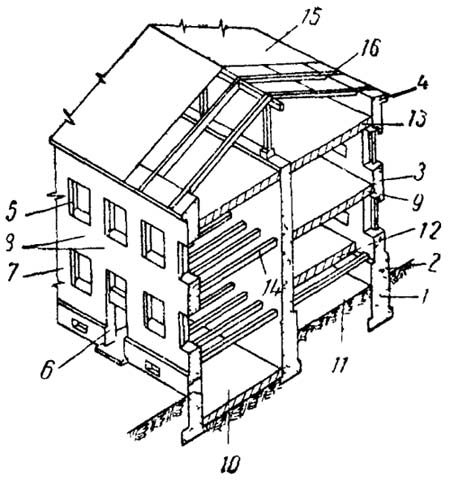
1 - фундамент;
2 - цоколь;
3 - поле стены (лицевая поверхность стены);
4 - карниз;
5 - оконный проем;
6 - дверной проем;
7 - простенок;
8 - перемычка (часть стены, перекрывающая оконные или дверные проемы);
9 - междуэтажное перекрытие;
10 - подвал;
11 - подполье;
12 - нижнее перекрытие;
13 - чердачное перекрытие;
14 - балки;
15 - кровля;
16 - стропила;
(15+16) - крыша[Грингауз Ф.И. Слесарь-жестянщик по промышленной вентиляции. Госстройиздат, 1959. 264 стр.]
Тематики
- здания, сооружения, помещения
- магистральный нефтепроводный транспорт
- опалубка
- теплоснабжение зданий
- энергосбережение
EN
DE
FR
конструкция
Устройство, взаимное расположение частей и состав машины, механизма или сооружения.
[ http://sl3d.ru/o-slovare.html]Параллельные тексты EN-RU
The new valve profile is design to ensure smooth and precise control at low capacities for improved part load performances.
[Lennox]Вентиль новой конструкции обеспечивает плавное и точное регулирование при низкой производительности холодильного контура, что увеличивает его эффективность при неполной нагрузке.
[Интент]
Тематики
EN
проектирование
Процесс разработки и выпуска проектной документации, необходимой для строительства объекта
[Терминологический словарь по строительству на 12 языках (ВНИИИС Госстроя СССР)]
проектирование
(ITIL Service Design)
Деятельность или процесс, который идентифицирует требования и далее определяет решение, способное удовлетворить этим требованиям.
См. тж. проектирование услуг.
[Словарь терминов ITIL версия 1.0, 29 июля 2011 г.]EN
design
(ITIL Service Design) An activity or process that identifies requirements and then defines a solution that is able to meet these requirements.
See also service design.
[Словарь терминов ITIL версия 1.0, 29 июля 2011 г.]Тематики
- проектирование, документация
EN
- construction
- design
- design engineering
- design planning
- design practice
- design procedure
- design study
- design work
- designing
- designing practice
- designing procedure
- designing work
- development
- development work
- drafting
- engineering
- laying
- laying-out
- planning
- project engineering
- project management
- projecting
- projection
DE
FR
размещение
—
[Я.Н.Лугинский, М.С.Фези-Жилинская, Ю.С.Кабиров. Англо-русский словарь по электротехнике и электроэнергетике, Москва, 1999 г.]Тематики
- электротехника, основные понятия
EN
3.3 конструкция (construction): Сварное изделие, сооружение или любая другая сварная продукция.
Источник: ГОСТ Р ИСО 3834-1-2007: Требования к качеству выполнения сварки плавлением металлических материалов. Часть 1. Критерии выбора соответствующего уровня требований оригинал документа
Англо-русский словарь нормативно-технической терминологии > construction
-
13 SG
1) Общая лексика: Salary Grade (SEIC)2) Компьютерная техника: Second Generation3) Медицина: Swan-Ganz4) Ботаника: Seed Growth, Seeded Gel5) Спорт: Sega Game, Shooting Guard, Small Game, Super G6) Военный термин: Scots Guards, Sea Going, Secretary-General, South Gate, Special Group, Standing Group, Suicidal Grenadiers, safety guide, screening group, security guard, senior grade, service group, shell, gun, smoke generator, standardization group, steering group, subgroup, sunset gun, support group, surgeon7) Техника: Screen Grid, Shuttle glow, Steam Generator, screw gear, signal, signal generator, standard guidelines, steam gage, Synthetic Gas, Syngas (Gasification Technology Conference)8) Химия: Seaborgium, Strat Gas9) Математика: стохастический градиент (stochastic gradient)10) Религия: Spiritual Gifts11) Страхование: Salutis gratia12) Астрономия: Shattered Galaxy, Star Graph13) Грубое выражение: Sexy Guitar, Shitty Gun, Sick Goatee, Sperm Gulpers, Spree Girl14) Музыка: Spare Guitar15) Политика: Senegal16) Телекоммуникации: Signal Ground, Study Group (ITU-T)17) Сокращение: Scots Guards (British Army), Singapore, Sorties Generated, Squadron Group (UK), StarGuard, Sub-Group, Surgeon General, structural glass, swamp glider, single-groove (insul)18) Университет: Select A Girl, Study Guide19) Физиология: Same Generation, Stern Gerlach20) Вычислительная техника: set gate, symbol generator, Signal Ground (MODEM)21) Нефть: shear strength, shows of gas, surface geology, винтовая передача (screw-gear), геология поверхности (surface geology), группа технического обслуживания (servicing group), признаки газа в скважине (showings of gas), червячная передача (screw gear)22) Иммунология: Super Germ23) Биохимия: Secretory Granule24) Связь: Signalling Gateway25) Транспорт: Ship And Goods, Solid Gear, Spruce Goose26) Фирменный знак: Savage Garden, Silicon Graphics, Singer27) Деловая лексика: Small Group, Study Group, Steering Group (бизнес)28) Бурение: удельная плотность (specific gravity), show of gas (gas in mud or cuttings)29) Глоссарий компании Сахалин Энерджи: плотность (specific gravity), удельный вес (specific gravity)30) Производство: руководящая группа31) ЕБРР: Secretary General32) Полимеры: screw gauge, senior-grade, sheet gauge, spark gap, specific gravity, standard gauge33) Программирование: Source Grep34) Пивное производство: Solution of Glucose35) Океанография: Sea Grant36) Сахалин Ю: security group37) Макаров: spheroidal graphite38) Электротехника: synchronous generator39) Фантастика Spectral Guardians40) Имена и фамилии: Samuel Gordon41) Должность: Salary Grade, Solicitor General, Sound Guy, Stud Guy42) Чат: Shy Guy, Single Guy, So Great, Speedy Gentleman43) Правительство: San Gabriel44) NYSE. Scientific Games Holdings, Corporation45) Программное обеспечение: Smart Generation, Solution Generator -
14 Sg
1) Общая лексика: Salary Grade (SEIC)2) Компьютерная техника: Second Generation3) Медицина: Swan-Ganz4) Ботаника: Seed Growth, Seeded Gel5) Спорт: Sega Game, Shooting Guard, Small Game, Super G6) Военный термин: Scots Guards, Sea Going, Secretary-General, South Gate, Special Group, Standing Group, Suicidal Grenadiers, safety guide, screening group, security guard, senior grade, service group, shell, gun, smoke generator, standardization group, steering group, subgroup, sunset gun, support group, surgeon7) Техника: Screen Grid, Shuttle glow, Steam Generator, screw gear, signal, signal generator, standard guidelines, steam gage, Synthetic Gas, Syngas (Gasification Technology Conference)8) Химия: Seaborgium, Strat Gas9) Математика: стохастический градиент (stochastic gradient)10) Религия: Spiritual Gifts11) Страхование: Salutis gratia12) Астрономия: Shattered Galaxy, Star Graph13) Грубое выражение: Sexy Guitar, Shitty Gun, Sick Goatee, Sperm Gulpers, Spree Girl14) Музыка: Spare Guitar15) Политика: Senegal16) Телекоммуникации: Signal Ground, Study Group (ITU-T)17) Сокращение: Scots Guards (British Army), Singapore, Sorties Generated, Squadron Group (UK), StarGuard, Sub-Group, Surgeon General, structural glass, swamp glider, single-groove (insul)18) Университет: Select A Girl, Study Guide19) Физиология: Same Generation, Stern Gerlach20) Вычислительная техника: set gate, symbol generator, Signal Ground (MODEM)21) Нефть: shear strength, shows of gas, surface geology, винтовая передача (screw-gear), геология поверхности (surface geology), группа технического обслуживания (servicing group), признаки газа в скважине (showings of gas), червячная передача (screw gear)22) Иммунология: Super Germ23) Биохимия: Secretory Granule24) Связь: Signalling Gateway25) Транспорт: Ship And Goods, Solid Gear, Spruce Goose26) Фирменный знак: Savage Garden, Silicon Graphics, Singer27) Деловая лексика: Small Group, Study Group, Steering Group (бизнес)28) Бурение: удельная плотность (specific gravity), show of gas (gas in mud or cuttings)29) Глоссарий компании Сахалин Энерджи: плотность (specific gravity), удельный вес (specific gravity)30) Производство: руководящая группа31) ЕБРР: Secretary General32) Полимеры: screw gauge, senior-grade, sheet gauge, spark gap, specific gravity, standard gauge33) Программирование: Source Grep34) Пивное производство: Solution of Glucose35) Океанография: Sea Grant36) Сахалин Ю: security group37) Макаров: spheroidal graphite38) Электротехника: synchronous generator39) Фантастика Spectral Guardians40) Имена и фамилии: Samuel Gordon41) Должность: Salary Grade, Solicitor General, Sound Guy, Stud Guy42) Чат: Shy Guy, Single Guy, So Great, Speedy Gentleman43) Правительство: San Gabriel44) NYSE. Scientific Games Holdings, Corporation45) Программное обеспечение: Smart Generation, Solution Generator -
15 sg
1) Общая лексика: Salary Grade (SEIC)2) Компьютерная техника: Second Generation3) Медицина: Swan-Ganz4) Ботаника: Seed Growth, Seeded Gel5) Спорт: Sega Game, Shooting Guard, Small Game, Super G6) Военный термин: Scots Guards, Sea Going, Secretary-General, South Gate, Special Group, Standing Group, Suicidal Grenadiers, safety guide, screening group, security guard, senior grade, service group, shell, gun, smoke generator, standardization group, steering group, subgroup, sunset gun, support group, surgeon7) Техника: Screen Grid, Shuttle glow, Steam Generator, screw gear, signal, signal generator, standard guidelines, steam gage, Synthetic Gas, Syngas (Gasification Technology Conference)8) Химия: Seaborgium, Strat Gas9) Математика: стохастический градиент (stochastic gradient)10) Религия: Spiritual Gifts11) Страхование: Salutis gratia12) Астрономия: Shattered Galaxy, Star Graph13) Грубое выражение: Sexy Guitar, Shitty Gun, Sick Goatee, Sperm Gulpers, Spree Girl14) Музыка: Spare Guitar15) Политика: Senegal16) Телекоммуникации: Signal Ground, Study Group (ITU-T)17) Сокращение: Scots Guards (British Army), Singapore, Sorties Generated, Squadron Group (UK), StarGuard, Sub-Group, Surgeon General, structural glass, swamp glider, single-groove (insul)18) Университет: Select A Girl, Study Guide19) Физиология: Same Generation, Stern Gerlach20) Вычислительная техника: set gate, symbol generator, Signal Ground (MODEM)21) Нефть: shear strength, shows of gas, surface geology, винтовая передача (screw-gear), геология поверхности (surface geology), группа технического обслуживания (servicing group), признаки газа в скважине (showings of gas), червячная передача (screw gear)22) Иммунология: Super Germ23) Биохимия: Secretory Granule24) Связь: Signalling Gateway25) Транспорт: Ship And Goods, Solid Gear, Spruce Goose26) Фирменный знак: Savage Garden, Silicon Graphics, Singer27) Деловая лексика: Small Group, Study Group, Steering Group (бизнес)28) Бурение: удельная плотность (specific gravity), show of gas (gas in mud or cuttings)29) Глоссарий компании Сахалин Энерджи: плотность (specific gravity), удельный вес (specific gravity)30) Производство: руководящая группа31) ЕБРР: Secretary General32) Полимеры: screw gauge, senior-grade, sheet gauge, spark gap, specific gravity, standard gauge33) Программирование: Source Grep34) Пивное производство: Solution of Glucose35) Океанография: Sea Grant36) Сахалин Ю: security group37) Макаров: spheroidal graphite38) Электротехника: synchronous generator39) Фантастика Spectral Guardians40) Имена и фамилии: Samuel Gordon41) Должность: Salary Grade, Solicitor General, Sound Guy, Stud Guy42) Чат: Shy Guy, Single Guy, So Great, Speedy Gentleman43) Правительство: San Gabriel44) NYSE. Scientific Games Holdings, Corporation45) Программное обеспечение: Smart Generation, Solution Generator -
16 program
1. программа/ программировать2. планair-breathing programblack programclassified programclimb programconstant altitude-constant airspeed programconstant altitude-constant lift coefficient programcruise-climb programdrag programfatigue programfinite-element programflight programflutter suppression programfull-scale development flight programglide programguest-pilot programhigh-angle-of-attack programlift programload programloading programMach box programmultistaged improvement programmultibody programperformance programpreplanned product improvement programproducibility engineering programre-engining programremanufacture programrewing programrewinging programrotorcraft programsmall disturbance programspinning programstall programsteepest-ascent programstepped-altitude programstructural programstructural loads programstudy programsupportability incentive programsweep versus Mach number programtest-flying programupdate programupgrading programvertical load program -
17 CSR
1) Общая лексика: central serous retinopathy, центральная серозная ретинопати, customer service representative, Социальная ответственность бизнеса ( СОБ)2) Биология: cortisol secretion rate3) Морской термин: Continuous Synopsis Record (журнал непрерывной регистрации истории судна), (Common Structural Rules) общие правила МАКО по конструкции и прочности (for bulk carriers or oil tankers)4) Медицина: Clinical Study Report (отчет о клиническом исследовании), Cheyne-Stokes Respiration5) Американизм: Center for Scientific Review6) Военный термин: Canadian Scottish Regiment, Coastal Surveillance Radar, Collection Support Requirement, Combat Search & Rescue, Council Situation Room, Current Situation Room, camp sentinel radar, chief of staff regulations, civil service retirement, combat search and rescue, combat surveillance radar, contract status report, control section report, controlled supply rate, critical shortage report7) Техника: check signal return, coaxial single-pole relay, command and status register, concentric storage rings, conical scan receiver, connected speech recognition8) Сельское хозяйство: Crop Suitability Rating10) Грубое выражение: Chelsea's Stupid Ranting, Completely Stupid Rhetoric11) Телекоммуникации: Customer Service Request, Customer Service Record, Call Success Rate12) Сокращение: Certificate Signing Request, Clean Suppressed Radiation, Container Summary Record (2008, IMB program), Control and Status Register, Covert Strike Radar, Customer Support Ruling (2007), communications satellite relay, control shift register, Control/Status Register13) Текстиль: Corporate Social Responsibility14) Вычислительная техника: Customer Service Representative (Telephony), Cell Switch Router (Toshiba)15) Организация производства: корпоративная социальная ответственность (corporate social responsibility)16) Фирменный знак: Cambridge Silicon Radio, Central Scientific Research17) Экология: Chemical Safety Report18) СМИ: Community Service Radio19) Деловая лексика: Company Statistical Rates, (Corporate Social Responsibility) Корпоративная Социальная Ответственность (КСО)20) Глоссарий компании Сахалин Энерджи: Company Site Representative21) Образование: Children Showing Results, Class Size Reduction22) Сетевые технологии: Channel Status Register23) Контроль качества: Crack Sensitivity Ratio24) Сахалин Ю: crack surface ratio25) Химическое оружие: control station room26) Авиационная медицина: computer service request27) Безопасность: запрос на подпись сертификата (certificate signing request)28) Электротехника: CSR-выпрямитель, тип тиристора (silicon-controlled rectifier)29) Фармация: отчёт о клиническом исследовании (Clinical Study Report)30) Майкрософт: представитель отдела обслуживания клиентов31) Евросоюз: Совет Старших Представителей (http://moscow-translator.ru/grammar)32) Должность: Certified Shorthand Reporter, Community Service Representative, Customer Support Representative33) NYSE. Central & Southwest Corporation34) НАСА: Critical Section Rlab35) Программное обеспечение: Control And State Register -
18 CSS
1) Общая лексика: circular seismic sounding (АД)2) Компьютерная техника: customer switching system, Content Scrambling System3) Медицина: carotid sinus syndrome, Churg-Strauss syndrome, Collet-Sicard syndrome4) Военный термин: COMSEC Subordinate Switch, Capability Support System, Central Security Service, Chief of Support Services, Chinese Surface To Surface, Collateral Support System, Combat Server Support, Combat Surveillance Service, Command Specific Server, Common Sensor System, Communications Support System, Comprehensive Smoke Study, Confederate States Ship, Contingency Support Study, Continuous Signature Service, clothing sales store, coded switch system, combat service support, combat shotgun system, combat support squadron, communications security section, communications security system, communications subsystem, composite service squadron, computer service squadron, contractor storage site, control subsystem, coordinated situation system, coordinator, surface search, система поддержки боя (combat support system), СПБ5) Техника: Carbon Structural Steel, calcium silicate slag, cask support structure, cast semi steel, cast stainless steel, coarse solar sensor, computer subsystem, computer systems simulator, condensate storage system, containment spray system, core spray system, core support structure6) Шутливое выражение: Contents Scramble System7) Религия: Catholic Social Services8) Фармакология: Steady-State Concentration9) Грубое выражение: Crappy Style Sheet10) Оптика: conical scan sensor11) Радио: Curvature Scale Space12) Телекоммуникации: Customer Service System, Общий центр обслуживания( ОЦО)13) Сокращение: Cascading Style Sheets (Web programming), Chinese Surface-to-Surface missile, Cluster Spectral Spreading, Cockpit System Simulator, Coherent Signal Simulator, Combat Supply System, Combat System Simulator, Command Support System (UK), Communication Support Segment for JSIPS, Communication Support System, Communications Security / Support System, Communications System Segment, Component Scheduling System, Computer Sighting System, Computer Support System, Consolidated Support System, Contingency Support Staff (USA), cast semi-steel, control stick steering14) Университет: College of Social Sciences15) Вычислительная техника: Cascading Style Sheet (Microsoft), Cascading Style Sheet, Cascading Stylesheets, Contact Start-Stop, Continuous System Simulator (Language), controlled flip seconds, cascading style sheets16) Нефть: computer support service, Циклическая паростимуляция17) Связь: call screening service18) СМИ: Content Scrambling Scheme19) Деловая лексика: Computing Support Services20) Глоссарий компании Сахалин Энерджи: Chevron success sharing21) Менеджмент: contract summary schedule22) Автоматика: constant surface speed23) Океанография: Central Support Services24) Авиационная медицина: Coriolis sickness susceptibility25) Безопасность: Client Security Software, СКЗ, Служба корпоративной защиты, Corporate Security Service26) Расширение файла: Datafile (CSS - Stats+ - Statistica)27) Нефть и газ: customer self-service, самообслуживание клиентов, (Syclic Steam Stimulation) стимуляция циклической закачкой пара, cyclic steam stimulation28) NYSE. C S S Industries, Inc. -
19 CsS
1) Общая лексика: circular seismic sounding (АД)2) Компьютерная техника: customer switching system, Content Scrambling System3) Медицина: carotid sinus syndrome, Churg-Strauss syndrome, Collet-Sicard syndrome4) Военный термин: COMSEC Subordinate Switch, Capability Support System, Central Security Service, Chief of Support Services, Chinese Surface To Surface, Collateral Support System, Combat Server Support, Combat Surveillance Service, Command Specific Server, Common Sensor System, Communications Support System, Comprehensive Smoke Study, Confederate States Ship, Contingency Support Study, Continuous Signature Service, clothing sales store, coded switch system, combat service support, combat shotgun system, combat support squadron, communications security section, communications security system, communications subsystem, composite service squadron, computer service squadron, contractor storage site, control subsystem, coordinated situation system, coordinator, surface search, система поддержки боя (combat support system), СПБ5) Техника: Carbon Structural Steel, calcium silicate slag, cask support structure, cast semi steel, cast stainless steel, coarse solar sensor, computer subsystem, computer systems simulator, condensate storage system, containment spray system, core spray system, core support structure6) Шутливое выражение: Contents Scramble System7) Религия: Catholic Social Services8) Фармакология: Steady-State Concentration9) Грубое выражение: Crappy Style Sheet10) Оптика: conical scan sensor11) Радио: Curvature Scale Space12) Телекоммуникации: Customer Service System, Общий центр обслуживания( ОЦО)13) Сокращение: Cascading Style Sheets (Web programming), Chinese Surface-to-Surface missile, Cluster Spectral Spreading, Cockpit System Simulator, Coherent Signal Simulator, Combat Supply System, Combat System Simulator, Command Support System (UK), Communication Support Segment for JSIPS, Communication Support System, Communications Security / Support System, Communications System Segment, Component Scheduling System, Computer Sighting System, Computer Support System, Consolidated Support System, Contingency Support Staff (USA), cast semi-steel, control stick steering14) Университет: College of Social Sciences15) Вычислительная техника: Cascading Style Sheet (Microsoft), Cascading Style Sheet, Cascading Stylesheets, Contact Start-Stop, Continuous System Simulator (Language), controlled flip seconds, cascading style sheets16) Нефть: computer support service, Циклическая паростимуляция17) Связь: call screening service18) СМИ: Content Scrambling Scheme19) Деловая лексика: Computing Support Services20) Глоссарий компании Сахалин Энерджи: Chevron success sharing21) Менеджмент: contract summary schedule22) Автоматика: constant surface speed23) Океанография: Central Support Services24) Авиационная медицина: Coriolis sickness susceptibility25) Безопасность: Client Security Software, СКЗ, Служба корпоративной защиты, Corporate Security Service26) Расширение файла: Datafile (CSS - Stats+ - Statistica)27) Нефть и газ: customer self-service, самообслуживание клиентов, (Syclic Steam Stimulation) стимуляция циклической закачкой пара, cyclic steam stimulation28) NYSE. C S S Industries, Inc. -
20 Css
1) Общая лексика: circular seismic sounding (АД)2) Компьютерная техника: customer switching system, Content Scrambling System3) Медицина: carotid sinus syndrome, Churg-Strauss syndrome, Collet-Sicard syndrome4) Военный термин: COMSEC Subordinate Switch, Capability Support System, Central Security Service, Chief of Support Services, Chinese Surface To Surface, Collateral Support System, Combat Server Support, Combat Surveillance Service, Command Specific Server, Common Sensor System, Communications Support System, Comprehensive Smoke Study, Confederate States Ship, Contingency Support Study, Continuous Signature Service, clothing sales store, coded switch system, combat service support, combat shotgun system, combat support squadron, communications security section, communications security system, communications subsystem, composite service squadron, computer service squadron, contractor storage site, control subsystem, coordinated situation system, coordinator, surface search, система поддержки боя (combat support system), СПБ5) Техника: Carbon Structural Steel, calcium silicate slag, cask support structure, cast semi steel, cast stainless steel, coarse solar sensor, computer subsystem, computer systems simulator, condensate storage system, containment spray system, core spray system, core support structure6) Шутливое выражение: Contents Scramble System7) Религия: Catholic Social Services8) Фармакология: Steady-State Concentration9) Грубое выражение: Crappy Style Sheet10) Оптика: conical scan sensor11) Радио: Curvature Scale Space12) Телекоммуникации: Customer Service System, Общий центр обслуживания( ОЦО)13) Сокращение: Cascading Style Sheets (Web programming), Chinese Surface-to-Surface missile, Cluster Spectral Spreading, Cockpit System Simulator, Coherent Signal Simulator, Combat Supply System, Combat System Simulator, Command Support System (UK), Communication Support Segment for JSIPS, Communication Support System, Communications Security / Support System, Communications System Segment, Component Scheduling System, Computer Sighting System, Computer Support System, Consolidated Support System, Contingency Support Staff (USA), cast semi-steel, control stick steering14) Университет: College of Social Sciences15) Вычислительная техника: Cascading Style Sheet (Microsoft), Cascading Style Sheet, Cascading Stylesheets, Contact Start-Stop, Continuous System Simulator (Language), controlled flip seconds, cascading style sheets16) Нефть: computer support service, Циклическая паростимуляция17) Связь: call screening service18) СМИ: Content Scrambling Scheme19) Деловая лексика: Computing Support Services20) Глоссарий компании Сахалин Энерджи: Chevron success sharing21) Менеджмент: contract summary schedule22) Автоматика: constant surface speed23) Океанография: Central Support Services24) Авиационная медицина: Coriolis sickness susceptibility25) Безопасность: Client Security Software, СКЗ, Служба корпоративной защиты, Corporate Security Service26) Расширение файла: Datafile (CSS - Stats+ - Statistica)27) Нефть и газ: customer self-service, самообслуживание клиентов, (Syclic Steam Stimulation) стимуляция циклической закачкой пара, cyclic steam stimulation28) NYSE. C S S Industries, Inc.
См. также в других словарях:
Structural communication — was developed in the 1960s by John G. Bennett and his research team to simulate the structure and quality of a small group tutorial through automated means. It provides access to high level learning for many students without much supervision. A… … Wikipedia
Structural geology — is the study of the three dimensional distribution of rock bodies and their planar or folded surfaces, and their internal fabrics . Structural geology includes features of and overlaps with facets of geomorphology, metamorphism and geotechnical… … Wikipedia
Structural engineering — is a field of engineering dealing with the analysis and design of structures that support or resist loads. Structural engineering is usually considered a speciality within civil engineering, but it can also be studied in its own right. [cite… … Wikipedia
Structural anthropology — is based on Claude Levi Strauss s idea that people think about the world in terms of binary opposites such as high and low, inside and outside, person and animal, life and death and that every culture can be understood in terms of these opposites … Wikipedia
Structural equation modeling — (SEM) is a statistical technique for testing and estimating causal relations using a combination of statistical data and qualitative causal assumptions. This definition of SEM was articulated by the geneticist Sewall Wright (1921),[1] the… … Wikipedia
Structural Integration — is a type of Alternative medicine which aims to align the human body in the gravitational field. [ [http://www.theiasi.org/whatis.php What is Structural Integration? ] ] The claimed benefit is that the increased use of balance at finer levels of… … Wikipedia
Structural biology — is a branch of molecular biology, biochemistry, and biophysics concerned with the molecular structure of biological macromolecules, especially proteins and nucleic acids, how they acquire the structures they have, and how alterations in their… … Wikipedia
structural analysis — ➔ analysis * * * structural analysis UK US noun [C or U] ► MANAGEMENT the study of a system, organization, industry, etc. to find how its different parts relate to each other: carry out/perform (a) structural analysis »He carried out a structural … Financial and business terms
Structural alignment — is a form of sequence alignment based on comparison of shape. These alignments attempt to establish equivalences between two or more polymer structures based on their shape and three dimensional conformation. This process is usually applied to… … Wikipedia
Structural parasitology — is the study of the structures of proteins for interesting parasites. It applies the techniques of structural biology (such as X ray crystallography or NMR) to determine the 3 D structures of protein molecules involved in a parasitic relationship … Wikipedia
Structural analysis — comprises the set of physical laws and mathematics required to study and predict the behavior of structures. The subjects of structural analysis are engineering artifacts whose integrity is judged largely based upon their ability to withstand… … Wikipedia
